You’ve lost a tooth, or you know you’re going to lose one, and your dentist has given you a few options. You could have an implant, a bridge or a partial denture. They can all replace a missing tooth, but the right choice depends on your teeth, your gums, your budget and what you want from the treatment.
Choosing between a dental implant, bridge or denture depends on a few things. Your bone and gum health, how many teeth are missing, your budget and whether you’re comfortable with surgery can all affect which option makes sense for you.
This guide compares implants, bridges and dentures on the things that matter most, including cost, durability and maintenance. It also explains who each option may suit, so you have a better idea of what to discuss with your dentist.
How Implants, Bridges and Partial Dentures Compare
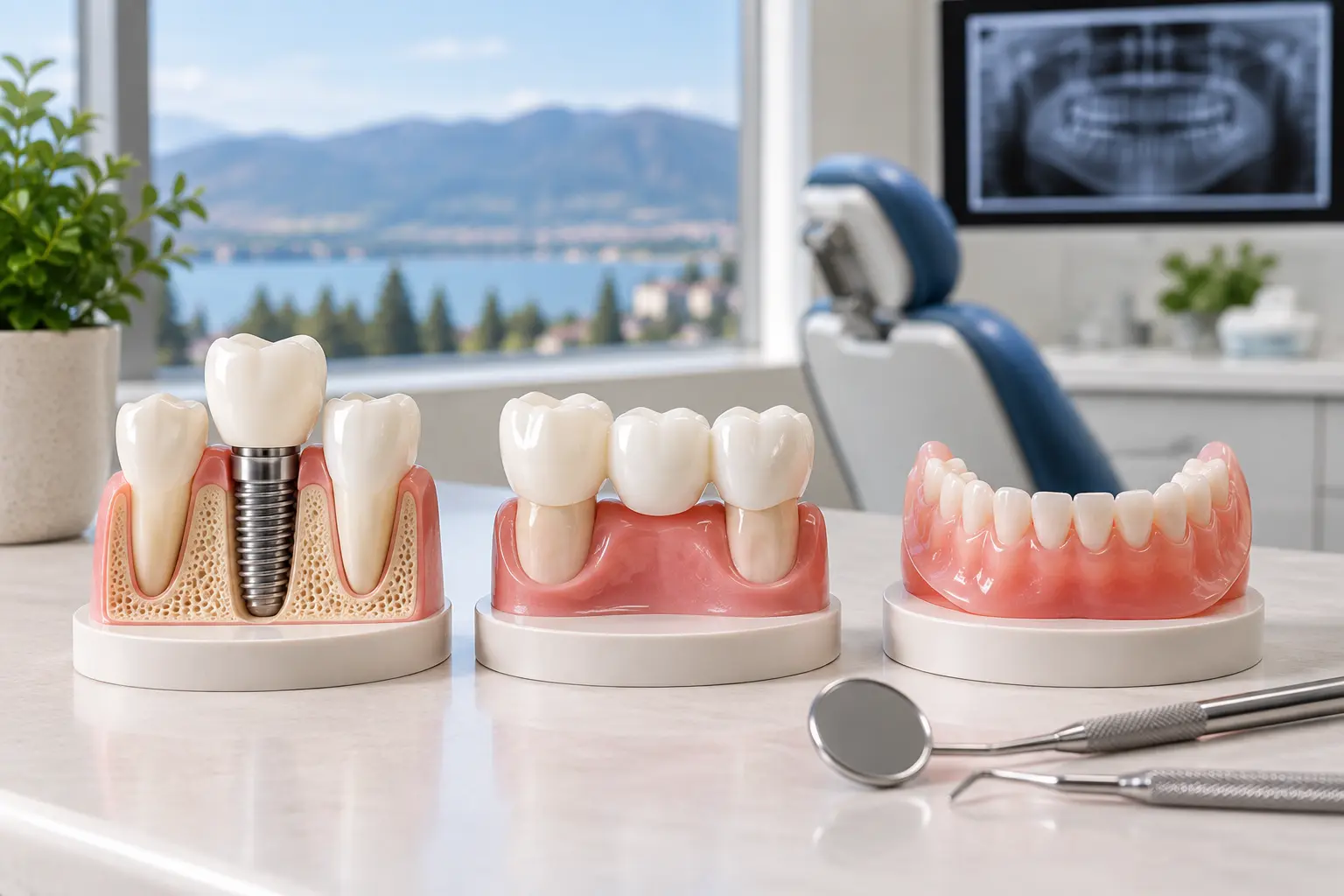
It helps to compare the three options on the same points. The table below looks at the factors that matter most, including cost, durability, maintenance and how each option works.
| Criteria | Dental Implant | Fixed Bridge | Partial Denture |
|---|---|---|---|
| What it replaces | One or more individual teeth, each with its own post and crown. | One to several teeth in a row, using neighbouring teeth as anchors. | One or several teeth anywhere in the arch, attached to a removable frame. |
| Surgery needed | Yes. Minor oral surgery to place the titanium post in the jawbone. | No surgery. The anchoring teeth are reshaped and crowned. | No surgery. Fitted and adjusted in the dental chair. |
| Lifespan | Can function for decades with consistent care. Failures do occur. | Typically lasts 10 to 15 years before the bridge needs replacing. | Lasts around 5 to 8 years. Fit may need adjusting as the mouth changes over time. |
| Effect on neighbouring teeth | None. Each implant stands independently in the bone. | The two teeth flanking the gap must be filed down and capped, even if healthy. | Metal or acrylic clasps attach to existing teeth. May place mild pressure over time. |
| Bone preservation | The titanium post stimulates the jawbone, slowing the shrinkage that follows tooth loss. | No bone stimulation beneath the artificial tooth. Gradual bone loss in the gap area. | No bone stimulation. Bone loss continues much as it would with no replacement at all. |
| Maintenance | Brush and floss the same way as natural teeth. Regular dental check-ups. | Requires a floss threader or interdental brush to clean underneath the bridge. | Removed daily for brushing. Soaked overnight in a cleaning solution. |
| CDCP coverage | Not covered. | Not covered. | Covered for eligible patients, with preauthorization. |
Implants involve surgery and usually cost more upfront, but they can last for many years with proper care. Bridges are fixed in place and can feel natural, though they require some preparation of the neighbouring teeth. Partial dentures are generally more affordable and don’t require surgery, but they need regular cleaning and may need replacement sooner than implants or bridges.
Who Is Not a Candidate for Dental Implants
Dental implants aren’t suitable for everyone. Your bone and gum health, overall health, smoking habits and ability to heal can all affect whether an implant is a good option. In some cases, another treatment may be safer or more suitable.
The condition of your jawbone matters when you’re considering an implant. The implant needs enough healthy bone around it to stay secure. If you’ve been missing a tooth for several years, some bone loss may have occurred in that area. Your dentist can check this with an examination and scans before recommending an implant. A bone graft can rebuild that foundation, but it adds months to the timeline and increases the total cost. Not every patient wants or is able to go through that additional procedure.
Some health conditions can make implant treatment more difficult. Uncontrolled diabetes can slow healing after surgery. Certain autoimmune conditions and long-term use of bisphosphonates for osteoporosis may also affect how the jawbone heals. Smoking can reduce blood flow to the gums and bone, which can make healing harder and increase the risk of implant problems. Digital imaging and a 3D scan let your dentist assess these factors with precision, though imaging alone cannot override a medical history that points away from surgery.
Age alone isn’t a reason to rule out dental implants. The jaw needs to be fully developed, so implants are generally not recommended for children and teenagers. Older adults can still be good candidates if they have healthy bone and are well enough for the procedure. Your dentist will look at your bone health and medical history rather than age alone.
People who grind or clench their teeth heavily may have a higher risk of damaging the implant crown. This does not necessarily rule out implants, though your dentist may recommend a night guard to protect the crown. The important thing is to get the grinding under control before going ahead with treatment.
Worth discussing upfront
An implant that fails during the healing phase means the post is removed and the bone needs time to recover before a second attempt. Failure rates are low, but they are real. Your dentist should talk this through with you before you commit.
When a Bridge Makes More Sense Than an Implant
- The neighbouring teeth already need crowns. A dental bridge can make sense when the teeth supporting it need crowns anyway.
- You cannot have implant surgery. A bridge may be an option if a medical condition makes implant surgery unsuitable.
- You are uncomfortable with implant surgery. If surgery is a major concern and sedation isn’t enough to make you comfortable, a bridge avoids the surgical part.
- You need the tooth replaced sooner. Bridges can usually be completed in two or three appointments over a few weeks, without waiting for an implant to heal.
- You are replacing a front tooth. Appearance becomes more important with front teeth, so the material and colour match need more attention. This can also affect the cost.
- You want to avoid bone grafting. A bridge does not require the bone grafting that some implant cases may need.
Where bridges work best
Bridges suit small gaps, one to three teeth, where the teeth on both sides are strong and well-rooted. Larger gaps or weaker anchoring teeth shift the recommendation toward implants or partials.
When a Partial Denture Is the Practical Choice
A partial denture is removable and replaces one or more missing teeth. It attaches to your remaining natural teeth and can be used when the missing teeth are in different parts of your mouth.
If you’re comparing a partial denture vs implant, cost is often a major factor. Partials generally cost much less than implants, and the Canadian Dental Care Plan may cover them for eligible patients with preauthorization. If you’re replacing several teeth, the difference in cost can become quite large.
A partial can also be the answer when surgery is off the table, whether because you’re not a suitable candidate, you don’t want surgery, or you need the missing teeth replaced quickly while you consider your longer-term options. Modern partials use lighter, more flexible materials than older designs, which tends to make them more comfortable and less noticeable than the partials people remember from a decade ago.
Bone health is the factor worth weighing most carefully between the two. A partial denture rests on your gums and attaches to your remaining teeth rather than being placed into the bone. Because it doesn’t replace the tooth root, it doesn’t provide the same stimulation to the jawbone as an implant. Over time, the bone under the missing tooth area can shrink, which may affect the fit and mean the denture needs adjusting or replacing.
What Each Option Costs and What Insurance Covers
Cost is one of the first things people ask about, and it deserves a straightforward answer. A single dental implant can cost around $3,000 to $6,000. A three-unit bridge is typically $2,500 to $4,500, while a partial denture can range from $800 to $2,500. For a detailed breakdown procedure by procedure, including how the BCDA suggested fee guide works and where the CDCP draws the line, our guide to how much dental implants cost in BC covers the numbers in depth.
Coverage is where a lot of patients get caught out. The CDCP covers partial dentures for eligible patients with preauthorization, but both dental implants and fixed bridges sit outside the program. Bridges are classed as fixed prosthodontics, which the plan excludes along with implants and every implant-related procedure. That makes the partial denture the only one of these three options the CDCP will contribute toward.
What you pay out of pocket beyond that depends on whether you have private dental insurance for tooth replacement and whether that plan covers the specific procedure.
Not sure which option suits your situation?
Book a consultation at Discover Dental and we’ll walk through what works for your mouth, your health, and your budget.
or call (778) 477-5554
How Your Dentist Assesses Which Option Fits
Your dentist will check your teeth and gums, review your medical history and use imaging to assess your jawbone. That examination is what determines which options are actually suitable, rather than which ones sound best on paper.
At Discover Dental, the process starts with a comprehensive exam, digital X-rays and a conversation about what matters to you. Cost, treatment time, comfort and long-term results can all be part of that discussion. Dr. Corey Hayward, one of the dentists at our Kelowna practice, weighs both your oral health and your overall health when talking treatment through. An implant may be a strong long-term option for one patient and the wrong call for another.
If you’re nervous about surgery or longer appointments, sedation dentistry can make treatment easier. It is available for both dental implant placement and tooth extraction, depending on what your treatment involves.
Your dentist should also explain what each option involves, how long it will take and what you can expect to pay. If you need a bone graft before an implant, for example, that can add several months to the treatment process, and it is better to know that at the planning stage than halfway through.
Implants, bridges and dentures aren’t the only restorative options either. If the tooth is damaged rather than missing, a filling, crown or root canal may be the better route. Our guide to tooth restoration options covers those in more detail.
Frequently Asked Questions
Can I combine treatments, like an implant on one side and a bridge on the other?
Yes, and many patients do exactly this. Your mouth is not required to have a single type of tooth replacement across every gap. If one area has strong bone and healthy neighbouring teeth, an implant makes sense there. If another area has a row of two or three missing teeth and the flanking teeth already need crowns, a bridge in that spot is often the practical choice. Your dentist looks at each gap individually rather than applying one solution across the whole mouth.
Can I start with a partial denture and switch to an implant later?
Yes, and many patients take this approach. A partial denture gives you a functional replacement while you save for an implant or while other health factors are being addressed. The one consideration is that bone loss continues under a partial denture, so the longer you wait, the more likely it is that a bone graft will be needed before the implant can be placed.
How do I know if my bone is strong enough for an implant?
Only imaging can tell you for certain. A standard dental X-ray shows the general bone level, but a 3D cone-beam CT scan gives the detailed view of density and volume your dentist needs to make the call. If the bone is insufficient, a graft can rebuild the area over several months before the implant post is placed. Bone grafting ahead of an implant is a well-established procedure.
Do dental implants ever fail?
They can. Early failure happens during the healing phase when the bone does not integrate properly around the post. Late failure, years after placement, can result from gum disease, excessive force from grinding, or infection around the implant. Failure is uncommon, but it is not unheard of. Your dentist should discuss the possibility and what a second attempt would involve.
Is a bridge better than a denture for replacing just one missing tooth?
Usually yes, if you can accept the tooth reshaping. For a single missing tooth where the neighbouring teeth are healthy, a bridge feels more comfortable day to day than a removable partial denture. The trade-off is that the bridge requires reshaping two healthy teeth to accept the anchoring crowns. If you cannot accept altering those teeth, a partial denture or an implant is the better route.
Can I eat normally with a partial denture?
Yes, once you adjust, which takes a week or two. Very hard or sticky foods may require extra care. The fit of the denture matters, because a well-fitted partial distributes chewing force more evenly and feels more stable. If the fit loosens over time, your dental office can reline or adjust it.
Related Guides
- Tooth restoration options compared across fillings, crowns, implants, bridges and dentures
- What dental implants cost in BC broken down stage by stage, with CDCP and insurance detail
- What a delayed cracked tooth costs you later when a repair turns into an extraction
- Dental implants at our Kelowna practice
- Our Kelowna dental practice and how to book an assessment